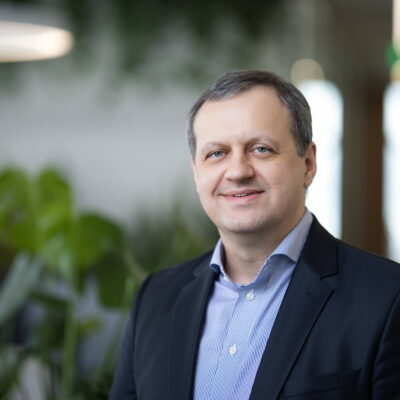
In recent years, Lithuania has made significant progress in improving access to finance for small and medium-sized enterprises (SMEs). However, there is still plenty of room for improvement. Business needs more clarity, faster decisions, and less bureaucracy when it comes to loan guarantees, said Raimondas Berniūnas, Chief Executive Officer at SME Bank.
“With the help of ILTE, the national development bank, we have already lent 38 million EUR to SMEs. But we could lend more, and faster. Access to finance for SMEs could be significantly improved by strengthening mutual trust between the public sector and banks, and by applying a FinTech mindset within the state sector,” says R. Berniūnas.
Although progress has been made in improving access to capital, the European Commission estimates that SMEs in Lithuania still face an annual funding gap of about 1 billion EUR. Lithuania remains among the EU countries where the financing gap is largest relative to the size of the economy.
According to R. Berniūnas, for Lithuanian businesses to feel a real improvement in capital accessibility, the state and the financial sector must join forces to achieve a breakthrough in several areas:
Greater trust in banks and their lending policies would help achieve a breakthrough. Access to financing increases when the system trusts banks as the primary filter. Each bank knows its client portfolio best. Giving banks more room to operate according to their own risk assessment policies would allow financing to reach even the smallest businesses.
A FinTech mindset and data management in the public sector. The state already possesses all the necessary data within the Center of Registers, Sodra, and the State Tax Inspectorate. By implementing data-driven automation, SME eligibility criteria could be verified instantly rather than taking several weeks. This is exactly how the FinTech sector operates.
Speed as a core criterion. In the reality of business, an individual guarantee that takes 2–3 months to process often becomes a missed opportunity. Money for salaries or raw materials is needed today. If the system cannot make decisions within a few days, it will hinder the country’s economic growth.
Business is creative and capable of adapting to state priorities, but support programs should not imprison companies within rigid sectoral boundaries. Furthermore, the financing system must encourage entrepreneurs not to fear making mistakes, falling down, and getting back up again.


 Sveiki
 Tere
Tere