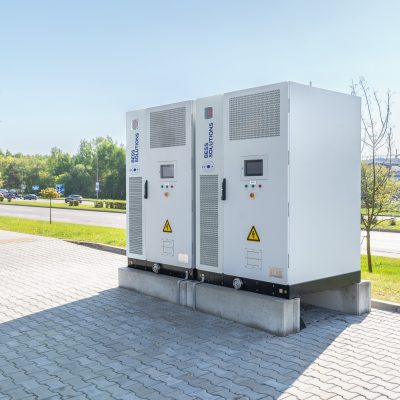
With the rapid growth of renewable energy capacity in Lithuania, small and medium-sized enterprises (SMEs) now have the opportunity not only to secure a renewable energy source but also to generate revenue from two distinct streams. By investing in Battery Energy Storage Systems (BESS), SMEs earn returns from both electricity price arbitrage and grid balancing services. The partnership between the digital business bank SME Bank and the renewable energy storage technology provider BESS Solutions offers companies a comprehensive, one-stop-shop solution.
“Our goal is to provide SME companies with financing that enables them to build sustainable competitive advantages. BESS projects are currently among the most attractive energy investments because they allow businesses to secure high returns—not only by taking advantage of electricity price fluctuations and price arbitrage, but also by providing vital balancing services to the grid,” says Marius Bačianskas, Head of Lending at SME Bank.

“Today, what matters most for a business is not just acquiring a battery energy storage system, but being confident that it is properly selected, integrated, and capable of generating the projected return on investment for years to come. That is why we start every project by assessing business needs and economic viability – analyzing electricity consumption and potential revenue from balancing services and electricity price arbitrage before selecting the optimal technical solution. We manage the entire project implementation lifecycle for our clients – from technical design and equipment selection to commissioning, integration, and long-term maintenance. This approach allows businesses to make decisions based not just on technology, but on clear economic value and a reliable partner throughout the project,” says Dainius Žukauskas, Sales Director at BESS Solutions.
When investing in BESS and power generation technologies, businesses need to ensure both a reliable source of clean energy and a clear return on investment. BESS projects are financed based on two main revenue streams: electricity price arbitrage and balancing service provision.
Electricity price arbitrage means a company can store cheap electricity – such as during sunny hours or at night-time tariffs – and consume or sell it on the market during peak hours when prices are highest.
Following significant investments in renewable energy generation across the country in recent years, the demand for grid frequency balancing services has increased substantially. Balancing services help stabilize grid frequency fluctuations caused by generation peaks on sunny days and energy shortages during low-generation periods. To provide this service, SMEs must invest in batteries alongside solar power plants. This balancing service currently generates the highest cash flows and delivers strong return on investment: early-adopter SMEs have seen payback periods as short as 1–2 years.
According to M. Bačianskas, to reduce the financial burden and risk for businesses, these projects benefit from European Investment Fund (EIF) sustainability guarantees and offer long-term financing of up to 10 years tailored to actual project cash flows. Furthermore, companies do not need to pledge additional collateral—the invested equipment itself, combined with the EIF guarantee, serves as security.
When evaluating the risk and viability of BESS projects, SME Bank applies criteria that ensure long-term project sustainability:
By combining BESS Solutions’ deep technical expertise, reliable equipment, and integration capabilities with SME Bank’s flexible financing structures and EIF guarantees, investment risk is minimized. Businesses no longer need to source technical partners and financiers separately; this combined expertise enables SMEs to deploy BESS systems rapidly and reliably, generate revenue from two streams, and turn energy independence into a sustainable competitive advantage.
For those looking to gain deeper insight into the implementation process and practical aspects of battery storage systems, the Baltic business conference “BESS: From Plan to Operation — The Full Project Lifecycle” brings together market experts, grid operators, engineers, financiers, and technology providers. The event will deliver a clear roadmap covering site selection, permitting, grid connection, financing models, construction, risk management, and long-term revenue maximization. More information and registration: https://bess-solutions.eu/bess-from-plan-to-operation-the-full-project-lifecycle/


 Sveiki
 Tere
Tere