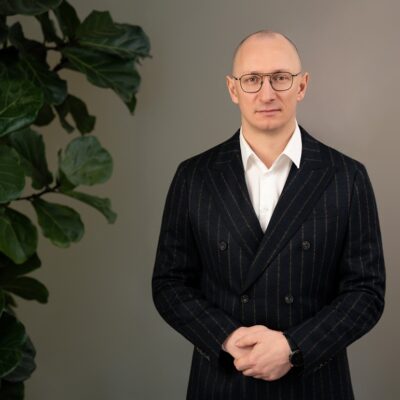
Managers of small and medium-sized enterprises (SMEs) often have to wear many hats, handling a wide range of business issues simultaneously. However, when it comes time to expand and secure bank financing, versatility alone is not enough. Marius Bačianskas, Head of Lending at SME Bank, advises on the homework that can simplify agreement with the bank.
“A bank views a business not just through data tables, but through the prism of trust. For an SME, ‘homework’ means high-quality, timely accounting data, a deep understanding of financial indicators, and a clear strategy. These are the foundations of a mutually beneficial partnership,” says Bačianskas.
According to him, submitting accurate financial reports on time is not just a regulatory requirement; for a bank, it is the primary indicator of how you manage your business. Banks notice how promptly you access your data. If you don’t know your January results by April, it signals a lack of control. His advice: aim to review the previous month’s results by the 15th of the following month.
Accounting must be transparent. Attempting to artificially reduce profit to avoid taxes is the fastest way to receive a rejection. The bank assesses an SME’s repayment capacity based on official figures. Furthermore, the expert advises keeping business and personal finances strictly separate; using a company account as a personal credit card is a red flag.
“It is not necessary for an SME manager to have a finance degree, but you must understand three main business financial indicators,” reminds the bank’s head of lending.
According to M. Bačianskas, the three main business financial indicators are earnings before interest, taxes, depreciation, and amortization (EBITDA), liquidity ratios, and margins.
EBITDA is essential for showing cash flow from core operations. Banks use it to calculate the Debt Service Coverage Ratio (DSCR). If this ratio is below 1, it means the company earns less than it needs to cover its debt, signaling financial distress. Liquidity ratios show if you can pay your short-term bills using current assets, while margins reflect your overall operational efficiency.
Strategic Planning
Bačianskas reminds managers that banks do not lend for “general needs.” You must justify the specific use of funds with facts. For example: “We are purchasing raw materials to fulfill a new contract that will grow our turnover by 5%.” A good manager also needs a Plan B. What if raw material prices spike? How will that affect your ability to repay the loan? Without a detailed market analysis, a strategy looks like speculation rather than a business plan.
How to Strengthen SME Financial Literacy
To strengthen financial literacy is possible by taking into help one’s accountant. M. Bačianskas suggests to treat the accountant not only as a person who submits declarations to the State Tax Inspectorate, but to turn him into a consultant. “Devote 1 hour per month not only to confirm numbers, but also for questions to the accountant: ‘Why did our self-cost rise this month?’, ‘What is our break-even or no-loss point?'”
Ask the accountant to create a simple “Excel” table, a so-called dashboard, in which you would see only the 3–5 most important indicators for you, for example, the money balance, EBITDA, and debtor debts, i.e., the sum of money which buyers owe the company for sold goods or provided services.
Take advantage of targeted courses or trainings. In Lithuania, organizations such as the “Innovation Agency” or business clubs often organize free or cheap trainings for SME managers about finance management and preparation for investments.
Use modern accounting programs which offer visual reports. To see the money flow curve visually is much easier than to analyze a gray column of numbers. Learn to use simple financial modeling templates, which allow to enter variables, for example, what will be if fuel costs rise 20% and immediately see the influence on profit.
“Consult with a bank manager even before submitting a financing application. A lending manager can indicate the weak places of your finances, which you will have time to fix,” advises M. Bačianskas.


 Sveiki
 Tere
Tere