Lithuania is home to two dozen banks, yet small and medium-sized businesses frequently remain with a single financial partner – out of habit, or under the assumption that all institutions offer the same. In practice, this translates into missed opportunities: weakened negotiating power, more costly credit facilities, and overlooked alternatives.
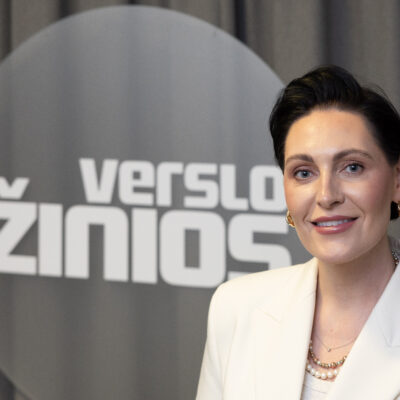
“The most common problem among small businesses is that the company is growing, but there is no cash in the account,” says Dovilė Bansevičienė, Chief Commercial Officer at SME Bank. This means that even as order volumes increase, payment obligations begin to stall. On paper, the business may appear profitable, yet in reality it lacks the working capital required to meet day-to-day payments.
According to D. Bansevičiene, this is partly because SMEs fail to utilise available financing instruments, are unaware of guarantee schemes offered by the national development bank ILTE or the European Investment Fund – which facilitate access to bank lending on more favourable terms – or simply do not engage in cash flow planning at all. Instead, decisions are driven by whatever the account balance shows on any given day.
A further common misstep, she notes, is pricing strategy: “Pricing is set by benchmarking competitors rather than by actual costs.” This means a business may be operating on inadequate margins – or even at a loss – without fully recognising it.
Meanwhile, the opportunities available in today’s financial market are considerable, and the landscape has changed fundamentally. A business account can be opened within a day, a financing decision obtained within 24 hours, and some banks now offer interest on current account balances without requiring funds to be locked away. Moreover, different market participants specialise in distinct areas, making it entirely rational to maintain relationships with more than one financial institution.
“A second bank is not bureaucracy – it is a tool for security and negotiation,” D. Bansevičienė affirms.
Listen to more in the ‘Verslo tribūna’ podcast with the Chief Commercial Officer of SME Bank.


 Sveiki
 Tere
Tere