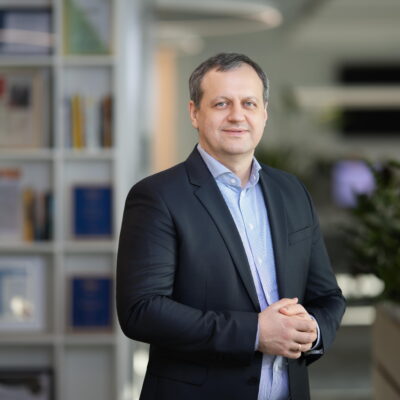
Increased competition in the banking sector is opening new opportunities for businesses to access faster financial services offered by digital neobanks. However, small and medium-sized enterprises (SMEs) still tend to work with only one primary bank. A reliable and flexible second bank has become a necessity for modern business – it helps fill the gaps in financial service needs that the primary bank cannot or does not have the time to satisfy, claims Raimondas Berniūnas, Chief Executive Officer at SME Bank.
“A second bank not only provides a company with an alternative for financial services but also ensures greater operational reliability. Furthermore, it strengthens a company’s bargaining position to negotiate better financing terms or earn additional income from interest on idle funds without committing to a fixed-term deposit,” says R. Berniūnas.
According to him, it has already become common to carry cards from at least two different banks in our personal wallets. If one bank experiences technical disruptions, offers unfavorable exchange rates abroad, or charges withdrawal fees, we simply pull out another card. Just as we value the freedom to choose payment methods in our personal lives, so it is in business – by having a digital partner alongside a traditional bank, an SME not only optimizes costs but also ensures that business does not stall due to slow bureaucracy or technical bank glitches.
The advantage of modern digital banks is that a business account can be opened remotely without leaving the office. This can usually be done faster than at the slower, traditional major banks. Digital banks have streamlined their Know Your Customer (KYC) and Anti-Money Laundering/Counter-Terrorism Financing (AML/CTF) requirements so effectively that a company can open a business account within 24 hours. In traditional banks, opening an account can resemble a hurdle marathon, where decisions are made slowly and requests for additional or even duplicating information are frequent.
Digital banks are hungry for new customers, therefore, they can offer a business opening an account a preferential daily banking service plan at a minimal cost or even for free for a certain period. Additionally, an SME can earn interest on funds in a current account at a smaller bank. This does not require entering into fixed-term deposit agreements. The company’s funds remain available for business needs, and if required, the accumulated interest is not lost. Smaller banks generally apply more favorable conditions for SMEs, such as a lower threshold for the minimum amount on which interest is paid for funds in a current account. Furthermore, in many cases, a smaller bank can offer higher interest rates than the primary bank would offer for an analogous amount (if they offered any at all).
SMEs are the backbone of the modern economy, yet their access to financing sources remains limited. Companies often apply for financing to only one or two banks. However, market concentration, where a few large banks hold the majority of the market, means that decisions regarding SME financing can be slow. Moreover, loans are often only granted if the company has suitable assets for collateral. With guarantees from business support institutions, such as the national development bank ILTE or the European Investment Fund, SMEs would require significantly less collateral to borrow.
Another feature of digital banking is the technological tools that allow for the automation of numerous operations. This helps avoid the so-called bottleneck effect, which often occurs due to a high volume of manual labor. Modern systems employing Artificial Intelligence (AI) can process large data streams in real time, which not only eases the workload for companies applying to the bank but also allows the bank to make informed decisions much more efficiently.
In business, time and uncertainty cost more than interest. If a primary bank deliberates on a financing decision for a month, a company may lose a profitable order. Digital banks using AI and automated processes provide answers within a few days.
For businesses involved in international settlements, modern digital infrastructure allows for faster international transfers and often more favorable exchange rates. This provides a direct financial benefit to the company in every financial operation.
SMEs still face the issue of lacking suitable assets for collateral. Traditional banks often lend only when suitable collateral is found. Digital banks focus more on the company’s cash flows and business specifics, offering flexible payment schedules.


 Sveiki
 Tere
Tere